Friday, July 16, 2010

GERMANY TRIP BLOG - DAY 15 – 6-6-10 – E. German traffic lights - Saxon Switzerland – Bastei Bridge – Elbe River

Marlies and I went down the elevator at the same time. Peter was already at breakfast. Huge variety of food, but only warm (?!) mineral water available, in small glasses. Breakfast was good (couldn’t believe how much I had to eat to fill up).
Marlies helped me as I worked on my German (she made sure I had all the right endings on the word variations). She hunts for the correct English word quite a bit, and sometimes uses pantomime plus the German word. Most of the time, we communicate just fine.
Dad wanted to walk. Matt returned the car. Peter went to smoke. Mom, Marlies and I talked. Marlies's mom and Gma. were a lot alike. Huge garden, lots of flowers, picked their own fruits and veggies, made jams, cakes, and other good stuff. And both houses they lived in are gone. Property sold and the land transformed, which just kills us and makes us sad. I nearly cried.
Mom talked about how Grandma loved harvesting walnuts, even when she couldn't see. She'd grope around under the trees, finding nuts. To crack them, she'd hold the nut on one end, then hit the top with a hammer.
We finally headed upstairs to get ready for today’s journey then met in the lobby. Marlies wanted her sunglasses. There was debate over whether she should walk 5 minutes to the car and get them. More discussion over whether Peter should walk or drive to the train station. We finally waited while Marlies got her sunglasses, Peter's cane, and a bag of nutty cookie things (which we ate most of on the train).
We walked and talked to the train station. I stopped to take a photo of a….

GRAMD BUILDING BY OUR HOTEL
Matt thinks it might be a museum.


FAT MAN TRAFFIC SYMBOLS
Matt showed me an older communist-Germany traffic light, with a fat man symbol indicating when pedestrians should stop, and when they can cross.

At the train station, Mom and Dad got tickets, then Peter and Marlies, but it took them forever because Peter can't hear so good, and neither could the clerk. Matt and I shared a delicious almond pastry.
Finally everyone had a ticket, but then Peter disappeared while we waited. He reappeared from the entrance, having snuck out to have a cigarette.
Once on the train, there was confusion (by even the Germans) over when to get your ticket punched and worrying that because we didn't, we'd be in trouble. We were fine. I read up on where we were going, finished deleting photos from yesterday, and learned more German.
I used my "It is all sausage to me," phrase, which I learned in a Smithsonian article about the diminishing butcher shops. Peter and Marlies laughed, but then I learned that the word I used for "sausage" is actually sort of crude. Peter uses it all the time, much to Marlies's frustration and embarrassment. Good thing I wasn't throwing that phrase around with anyone else.

We took a ferry across the river, then Matt and I set off to walk up the trail to the top of the mountain, while everyone else went to the beer garden.


SAXON SWITZERLAND ("Sachsische Schweiz:) NATIONAL PARK
This isn’t part of Switzerland, but many think so. There's a lot of "just sandstone rocks" that look like castles from the1300's. The sandstone was used to make the Berlin Gate. In 1982-84, some of the stuff was reconstructed, while archeologists dug down and confirmed people lived here.
I took pictures of tiny people were on top of some of the rocks.

It was really hot and we were outside, in nearly 90 degree weather, walking, and standing. The 30 minute walk was mostly, but not always shaded. Part of the trail led through the forest, where a man standing near the trail sang beautifully in German. Just his voice, ringing through the trees. Lovely!
Took photos of rocks that look like ruins from the train tracks, and as we walked up. Someone turned an old castle into a hotel.

ONE TREE ON HIGH ROCK – tall rock, with just one tree. On the way back, there were two people standing next to the tree. (More crazy hikers.)

Various side paths led to the top of rocks. From behind the rail we looked out over the towns (white roofed rectangular building is the beer garden where everyone else was hanging out), river (which was a dirty brown, moving faster than normal, and swollen from the recent rain), and surrounding rocks.

BASTEI BRIDGE – 1851 – Created purely as a romantic lookout. First scenic photos of the area taken there. One side of the bridge allowed us to look over the…

ELBE VALLEY – 900 ft. below.
ELBE RIVER
FORTRESS KONIGSKIN – At the top of a far hill, the river flows around it – great place to build a lookout fortress.

BASTEI BRIDGE – The other side of the bridge looks over more big sandstone rocks and…

FELSENBERG "Fortress" NEURATHEN – 1200's Saxton fort 50 yards before the bridge.
&
STATUE ON ROCK – plus two (insane) climbers sunbathing.

We made it to the top, which had a few shops and cafes, including a
HUNDEBAR – with 2 bowls for dogs to drink out of.

2002 FLOOD
Matt bought me postcards with great photos of the bridge and one of the 2002 flood.

Walking back through the village, there was a building with little metal signs on it, showing how high various floods through the centuries hit – including the 2002 flood.
Matt suggested we walk to the beer garden. I had no idea it was so far (10 minutes walk in the 90 degree weather). No shade. No one in the beer garden.
Matt bought and ate a hamburger. None of the sandwiches appealed to me, so I got ice cream (but the bar left me hungry). Rested on a bench. Matt snagged a beer and bought me a bottle of cold, regular water. I nearly cried, it was so delicious. I scarfed some jerky (desperate for protein), the last of Marlies's cookies (she gave them to me), and a bar.
Matt found Dad walking around. The others were inside, drinking iced coffee. Matt learned our boat wasn't running on the river, due to the flood, so we had to take the train back.
TRAIN STATION – Finally got a picture of everyone in one shot - Marlies, Peter, Mom, Dad, and Matt!

BASTEI BRIDGE
On the train ride home, Matt told me when it was about to appear, so I could snap a picture of it. Deleted photos during the rest of the ride.

Walked back chatting with Marlies. She knows the raw finely chopped pork spread we read about in Smithsonian. Said it was good, though not (as the article stated) necessary to get the meat from butcher. She prefers butcher meat, but it costs more, so she normally uses the store.
Finally got a picture of
GOLDEN HORSE – by our hotel

Back in our hotel, still hungry, I ordered food from Room Service. After I begged, Matt helped me figure out what buildings in Old Town Dresdin I took pictures of yesterday. (Usually I take notes as I click away, but didn’t want to slow anyone down as we wandered, so figured it’d be easy to do later. I was wrong.)
While I ate, Matt went for a swim. He came back, all excited. The smaller, hot-tub pool has a extra jet in 2 corners. You press a button and a downward pointing, 2-3 inch in diameter nozzle pushes water out. I put on my suit and walked to the pool while everyone else ate in Old Town.
Swam and worked out in the wonderful, 5 foot high water all over pool An African gal 10 years older than me and her German husband swam with me as we talked. He left. We kept talking and swimming. We both got cold at once.
I went into the shallow hot tub and tried the jet thing Matt talked about. Great massage! I used it all over my body. I want one in our house. Eventually, regretfully, I got out, showered, ate a snack, then typed notes on the PC until midnight.

Thursday, July 15, 2010

GERMANY TRIP BLOG - DAY 14 – 6-5-10 - OLD TOWN DRESDEN – Parade of Nobles – Franken Church

Got up before the others, around 7:30, starving, so went down to breakfast before everyone else.
The eating area crowded again. Sat at a table with a couple. The lady had a neck brace on. I think she hurt herself boxing. Her husband trains her (he boxed but lost his first match and gave up since he wasn't winning enough). They left shortly before Matt and my folks arrived.
Back in the hotel we packed up, and Matt loaded the car.
We walked to the grocery store and bought additional food to eat during today’s long drive. We drove away around 10:00.
I read and highlighted info. about stuff we saw on June 3rd, then Dachau, and finally things we'll see in Dresden. After lunch, read a funny sci-fi story (I’d read the night before) out loud. Mom laughed. Knew she would.
We ate lunch at a picnic table at a rest stop. The toilets were pretty gross. I changed my mantra, "If I can do Italian toilets, I can do anything." Took a pain pill with lunch (meat, bread, light potato chips that were super tasty, cherries, and the last few cookies Marlies sent with Mom for our trip). A while later, took an anti-nausea pill, which helped. Ate more candy (reading to myself from the sci-fi anthology) and finally felt the discomfort and nausea recede.
We filled the tank with gas and a teenager washed our windows. He had a scar on his neck from a 3rd degree burn. Matt wasn't sure if he was supposed to tip him or not, so he did. The guy was super happy. We drove on to our hotel. We were in the car 3 1/2 hours.

We stayed in a Westin that was pretty fancy (and Matt said cost more as a result). We checked in, let the porter take our luggage up. Matt returned our rental car. I learned from the porter how to say "New Town" and "Old Town" in German. A bridge over the river divides the town. Mom fished out some money so I could tip the porter. Our rooms are on the same (no smoking) floor, but a long walk away from each other. Matt arrived at the same time as our porter.

DRESDEN
We walked in the hot (but not super unbearable) sun around Old Town Dresden.

AUGUSTUS BRIDGE – Reconstructed. Built over the Elbe River. Connects New Town to Old Town.
During 2002 floods, water came 2/3 up the arches.

ALBERTINIUM – Reconstructed historical building. Museums inside are under reconstruction until 2011. Surreal to know that work is still being done so long after the WWII bombs.

KING JOHN – Reconstructed. Black statue of King John (mid-1800's ruler) on a horse.


ZWINGER PALACE – Reconstructed. Shiny new clock on outside.
Home of the Witten dynasty. They ruled Saxony for 800 years – until WWI. Augustus the Strong (prince elect of Saxony & King of Poland) kicked off Saxon's golden age.
"Zwinger" means the no man's land running along the city wall.

PARADE OF NOBLES - 1907 – mural located on the back of the palace.
24,000 tiles of Meissen porcelain (fired at 24,000 F). 700 years of Saxton royalty. Authenticity attempted for costumes, weapons, etc.. Dates and names are written below the important people. Wilhelm Walther, the artist, put his face at the very end of the mural (also the most current section). He’s facing out from a group of common laborers. Near the middle, 1694, is August the Strong, with his horse stomping on a rose (symbolizing Martin Luther to gain the Polish crown).


HOFKIRCHE (Hof Church) – Reconstructed. Green copper steeple
Built by August the Strong's son (a Lutheran) because the Pope would only allow him to be King of Poland if he built a Catholic church in Dresden. 5% of the people in the town today are Catholic.


SAXTON STATE OPERA HOUSE – Reconstructed. Nicknamed "Semperopter" after architect, Gottfried Semper

PALACE OF CULTURE MURAL – 1969 (earlier, we mistook it for Parade of Nobles by accident)


FRANKENKIRCHE – (Church of our Lady) – Reconstruction finished 2005. Original built 1743. Black stones seen outside are originals (about a third of them). They’ve been put back in their original position. MARTIN LUTHER – Stature outside church

ALTAR - 80% original material (2000 pieces put together). Shows Christ praying in Garden of Gethsemane, surrounded by angels.
The cross in the center of the altar is 2 nails from a sister city that was obliterated in the nearby town of Coventry, England.


TWISTED CROSS - Near the exit is a twisted cross that was on top of the church when it was bombed in WWII. It was lost in the rubble until 1995, it's where they found it. The new cross on top of the church was made by a coppersmith, son of one of those who bombed the church.
DOME – Outside the church, there’s a hunk of rubble from the dome. A small metal picture of the church placed on the piece of dome shows hole where the hunk came from.

BALCONY OF EUROPE – "Bruhlsche Terrace" – located by the Elbe River

Once Dresden's defensive wall. Circles with an "X" in the middle show openings for canons.

Lots of street performers out today. One guy, below the mural, had gray makeup on his skin. His jacket and hat were the same color. Black material fell from the back of the golden frame. Looked like he was a painting, until he moved or if you looked at him from a different perspective. Very clever.
Mom and I stopped and got 2 (small but tasty) scoops of ice cream.

I was hot, thirsty, and tired as we walked back to our hotel. No word or call from Peter and Marlies, who are supposed to join us here. Matt read an English newspaper. Mom and I were about to go to our rooms, when Mom heard Peter, so she went to him. Matt said Peter and Marlies have to check in and go up to their rooms anyway, so I went to our room – famished.
Ate and watched some TV, then suddenly got sleepy even though it was only 6:00.
Fought it off as I typed notes of what we did today.
I was SO SLEEPY, Matt suggested I stay in the room tonight and use Room Service for dinner. He met with Mom, Dad, Peter, and Marlies. I ate, organized my suitcase, and then was awake, so sorted photos (over a day behind). Got sleepy again and fell asleep around 9:00. Matt couldn't believe I wasn't on the computer when he came in.

Wednesday, July 14, 2010

GERMANY TRIP BLOG - DAY 13 – 6-4-10 - Dachau Concentration Camp

Woke up at 6:45. Laid in bed. Cuddled. Hungry and wide awake. Matt was also awake and I was starving (been hungry since yesterday's lunch). Remembered I had food bars so sucked down one of them while we watched CNN. Got dressed and headed downstairs 30 minutes before everyone else.
The dining area was crowded with the new hotel guests. The male and female server were working. I asked her for my 3 eggs. He found me a small table and asked (in German) where my family was. I explained (in German) they were coming in 30 minutes. He understood. I ate 3 eggs and 2 croissants (with jelly).
Matt, Mom, and Dad arrived before I finished eating. I went upstairs and worked on yesterday's Diary for about 40 minutes. We all left for the subway together (so Matt use our ticket, saving Mom and I paying for additional tickets). We all went to Mary's Place and figured out what time to meet by the statue (around 3:30). Mom and I wanted to tour the Duchau concentration camp. We both felt the same pull. Matt and Dad felt the opposite, so they went to the "German Smithsonian" Transportation Museum, then the Hunting and Fishing Museum.
An American (from Wisconsin) held up tour signs, and soon Colette, our tour guide arrived (ex-program manager from PBS in L.A., CA). Both learned German while here. Both had been here nearly 3 years. Our tour guide told us we had time for the bathroom and to snag food, if we wanted to eat in the next 5 hours. I was still hungry, so I bought 2 half sandwiches, 2 croissants, and what I hoped was a big cinnamon roll, but wasn't nearly as tasty.
There were about 20 of us on the tour. 4 ladies from TN, 1 gal from TX, a couple in their 50's from New Zealand (touring Europe since they were here for their nephew's wedding – 21 hour plane ride to get here!), a guy from Brazil, and one from Australia (very friendly and took even more photos than I did).
We got on the subway, which went above ground eventually. While on it, we paid the 19 Euros for our tour, which included transportation. Colette assured us she never lost anyone getting to Dachau, but admitted sometimes people leaving the concentration camp hit the nearby McDonald's, and then she loses a few.
We got off the train and onto a public bus, which we rode about 15 minutes to get to Dachau.


DACHAU (Germany’s 1st Concentration Camp)
During WWI it was a military base. When Germany lost, they were forced to disarm, so it was abandoned until it was opened again in 1933 when Hitler became head of the Nazi party.
Hitler wanted to head up the Nazi's in the 20's, but it was a time of money – The Roaring ‘20's, and a bad time for socialism to start up. So he waited, knowing eventually the market would fall, as it always does, and then he'd try again.
In the ‘30's, the stock market crashed. It was the Nazi's who started up the Soup Lines. People were poorer, times were hard, and everything was just right for Hitler to try again with his Nazi's.
A theatre caught on fire while it was full and a bunch of Germans died. It was definitely arson and probably started by the Nazi's, who claimed Russians were to blame. This "terrorist attack” allowed Hitler to declare a state of emergency, which meant anyone could be thrown into prison for any reason (real or not), without a trial, for as long as the government wanted.
This scared the crap out of everyone. The jails were filled as blacks, Jews, Catholics, homosexuals, real criminals (used in prison camps to be in charge of the other prisoners – perfect work for psychopaths), gypsies, Jehovah's Witnesses, and anyone protecting these people or who was considered a threat. Anyone with mental or physical defects went to a castle "for treatments" paid for by the government where they were secretly given lethal injections.
Jews were put into grottos, and the idea was to keep them in there without food, water, or medicine, until they died and rotted. But there were still too many, so they were put on trains and taken to prison camps.
Dachau was the first, and became a model for all the other concentration camps. Next to Dachau was the S.S. training camp. When the first prisoner arrived, one guy hit a guard on the head and escaped. He went to Czech. where he printed his story in four different languages, but no one paid any attention.
The Nazi's made sure this never happened again. There was a moat outside the electric fence as well as a dry one inside. Inside the inner moat, they grew a strip of grass, several feet across - called the Death Grass. If a prisoner put one foot on it the guards were supposed to shoot them. Guards earned extra time off for every prisoner they killed.


One of the "games" the guards played was they'd knock a prisoner's hat onto the Death Grass. The prisoner didn't know if he should go after his hat, and risk getting killed. If he appeared in Role Call without his hat, he’d be sent to the Punishment Room where he’d likely be tortured to death. Sometimes the guard was just mentally torturing the prisoner, and didn't kill them for retrieving their hat from the grass.
When people first entered, they had to leave all possessions - letters, recipes, photos, etc. This stripped prisoners of their past and personality. Their heads shaved. In the prison camp, anyone who couldn't work was killed off immediately. The rest were worked to death, or killed for any reason at all. Most made the weapons for the Germans.
Another “game” guards participated in was telling prisoners they were going to be executed. They’d blindfold them, line them up, and shoot their guns in the air instead of at the prisoners. Just to watch them jump.
Some people tended herb gardens and were used as medical experiments to see what the herbs did. Many died because the herbs were poisonous, from an O.D., etc. Dachau was also the special prison for priests. Catholic priests burned the bodies (goes against their faith) and removed the ashes. Rabbis tended pigs. Anything to degrade and psychologically torture them.
30,000 people died in Dachau between 1933-45. Over 1 millions killed in Auschwitz.
In 1945 the Jews were liberated. During the Holocaust, people in surrounding towns suspected and heard rumors of what went on. Hitler allowed and encouraged rumors, because it left people fearful and uncertain just how bad things really were, so they’d fear for their own lives and do as ordered. Still, they had no real idea of the horrors until they were forced to visit Dachau. Even seeing skeletal bodies (in huge piles because Nazi’s ran out of coal to burn them), they couldn’t take it in as they walked away, weeping and shaking their heads.
Even after they were freed, prisoners still died because the nice soldiers fed them lots of chocolate and rich food, which their systems couldn't handle. Their bodies couldn't process the chocolate, which put them into comas and they died. Sometimes their stomach's just exploded. Doctors figured out what was happening and someone put them on a special diet, where they were still fed very little, slowly eating a bit more, until their bodies could handle real food.
After serving as a prison for Nazi leaders, Dachau became temporary housing for Germans who'd been in Czech. and kicked back to Germany after the war. Their homes were gone and they had no place to go. They turned the camp into a village, making it a bright, happy place, with a theatre, cinema, grocery store, etc.
The German govt. was going to demolish the place and put up condos. Those imprisoned here spent 20 years in court until they won the right to leave it as a memorial so their time and all the deaths wouldn't be wasted. Never forget. They rebuilt a few of the original buildings.
Today, aside from tours, the area is used to train Bavarian riot police.


We started by watching a 20 minute film with real footage filmed by Nazis and American soldiers who freed the Dachau prisoners. It also provided a short history of Hitler and the Nazi party. Then it explained how the prison camps worked and how the prisoners heard nearby fighting and just tried to live a few more days or hours until they were freed. It showed people from nearby towns who were shown bodies piled in rooms. They all shook their heads in shock and disbelief. Many cried as they walked away.
After the movie, Mom told me it's possible some of our relatives (Beise's or Pattons) were killed here. After WWII, her relatives contacted the Red Cross to find out what happened to their German relatives. The Red Cross checked their lists of people still alive and said, "There are no survivors." We don't know what happened to them.
Really wish she'd told me this earlier, before we arrived. Terrible timing, but I hadn’t realized it. Maybe it’s why we felt drawn to see the place. We talked about how the area feels different. Mom told me the house Abe Lincoln died in feels sort of the same way. There’s a sense of great loss and sorrow.


DAY HOUSE – Where the entry gate was. The phrase on the gate translates "Work Means Freedom" or "Work Sets You Free". The gate is a replica. No one knows where the real one is.


PERIMETER - Death Grass, canal, barbed wire electric fence (where prisoners committed suicide by throwing themselves onto it), and the outer moat. The bridge over the moat wasn't there originally. Everything else is a replica.


CREMATORIUM – 1940 – At least 11,000 people were burned in it.
When the Nazis needed a bigger crematorium, they built “Barrack X” outside the gate (to hide the horror from prisoners and camp visitors). It was built in 1942-43 by Catholic Priests. The "X" was the code name for the gas chamber, which was maybe tested once, but never used (for reasons no one understands).
Prisoners were hung in front of the crematorium. During the last few months of the war, there wasn't enough coal anywhere, so bodies piled up.

MEMORIALS –
3 Religions
Left side – Protestant
Center – Catholic
Right – Jewish Memorial – all building material came from Israel (no German material).

Suicide Memorial – 1967 – Big black sculpture in front of the white Maintenance House. The bodies represent prisoners who committed suicide on the electric fence as well as the piles of dead bodies.

BARRACKS – OUTSIDE - There are 2 replicas. Outlines of where the rest were are represented by large cement rectangles. There was a row on either side of the poplar trees (which only live 40 years, so new ones get planted in the same place).. Each of the 4 rooms had 50 prisoners (or more) crammed into them.

BARRACKS – INSIDE – Replica shows three versions as they changed over time.
1 – Before WWII the original barracks gave each person their own space. Beds were like troughs. Prisoners had a mattress, pillow, and blanket.

When they got up at 4:30 and had to make sure (as a form of torture) that their beds were perfect. No straw sticking out of mattress. Pillows perfectly lined up with those on either side. Blankets with plaid design laid so all the lines were perfectly lined up with the blanket next to it. Floor scrubbed spotless.
Then they got breakfast and had to be at roll call by 6:30. Sounds like plenty of time, but much of it was spent making the beds, plus the farther you were from the roll call area, the longer it took to get there.
2 – No dividers between each beds. Just a bunch of flat, wooden boxes laying in rows. Each prisoner got a pillow and a blanket. No mattress. Prisoners got 2 foot lockers to store their bowls, fork and spoon. Bowls had to be placed in the exact middle of the locker.
Meals rarely contained meat. Soup served daily. People took turns being served first for the soup line, and Jehovah's Witnesses made sure the sick people weren't in front. (All the good stuff falls to the bottom.)


3 – By 1942 there was no space. No locker rooms. Beds were essentially a large box that people laid in. Because of Typhus, it was healthier to sleep outside the barracks.

WASH BASINS & URINALS – original – (Brought back to Dachau.)

MAINTENANCE HOUSE – Original building. Looks like half of the outline of a rectangle. White building with the huge body pile sculpture in front of it. Now it's a museum.
Mom put her hand on the large map where the Beise family "town" of 4 houses was.

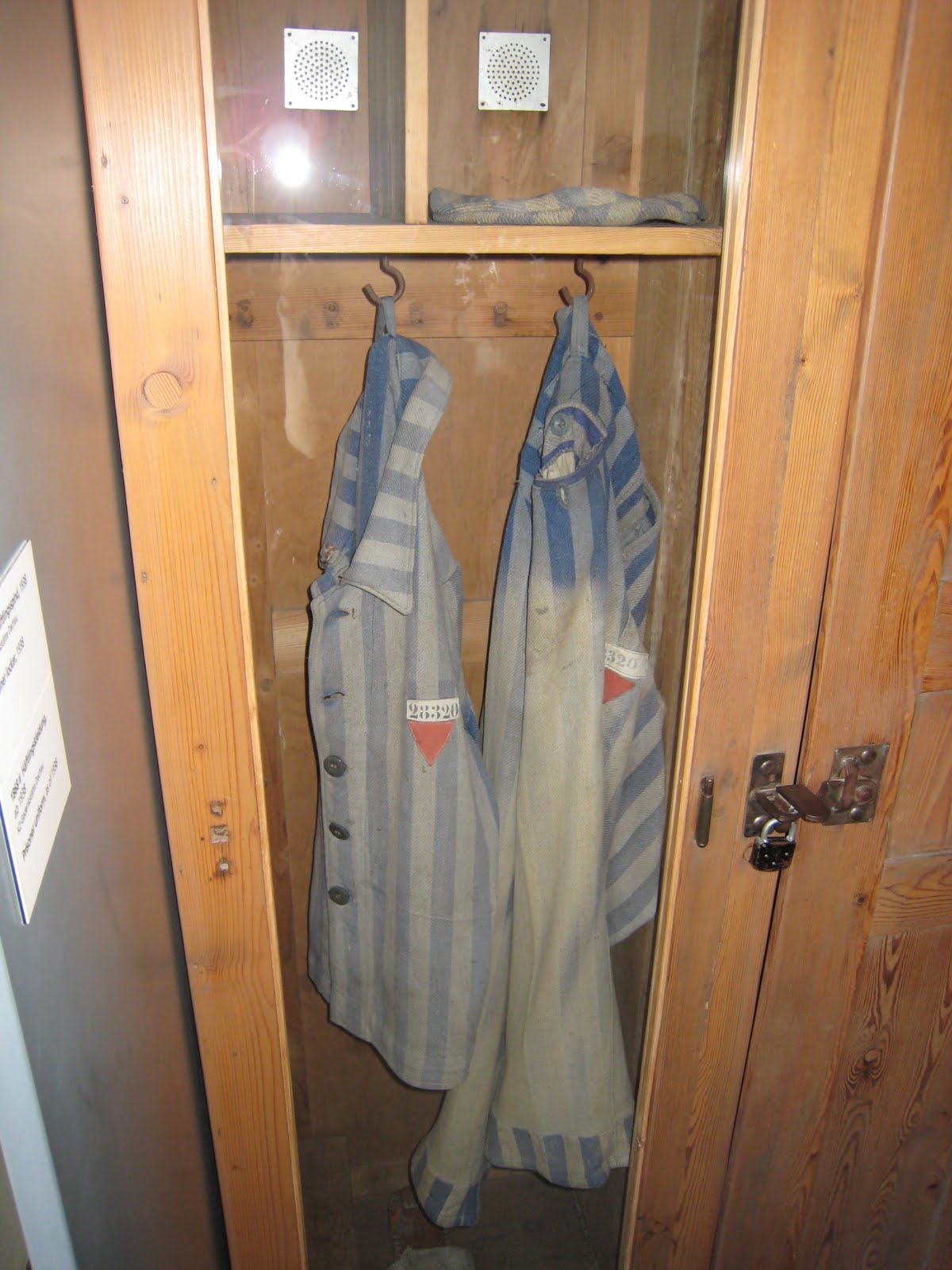
Saw a real prisoner uniform. The color of the triangle distinguished why the prisoner was in the camp:
Yellow on sleeve and back of neck – Jew.
Pink– homosexual.
Green – criminal.
Black – blacks, gypsies, misc.
Purple – Jehovah's Witnesses.
Red – Catholic (I think).
Purple band around arm - prestigious prisoner.
Prisoners were subdivided to promote infighting (which prevented them ganging up and organizing resistance).

BUNKER – Original building & doors. The building is behind the Maintenance House. Used for punishing regular inmates and holding VIPs – captured dignitaries Hitler hoped would report good treatment so their country would join the Germans. VIPs got their own rooms.
Most of the rooms were alike – bare and small. Took shots through a hole in a locked door into a room had a long sink.

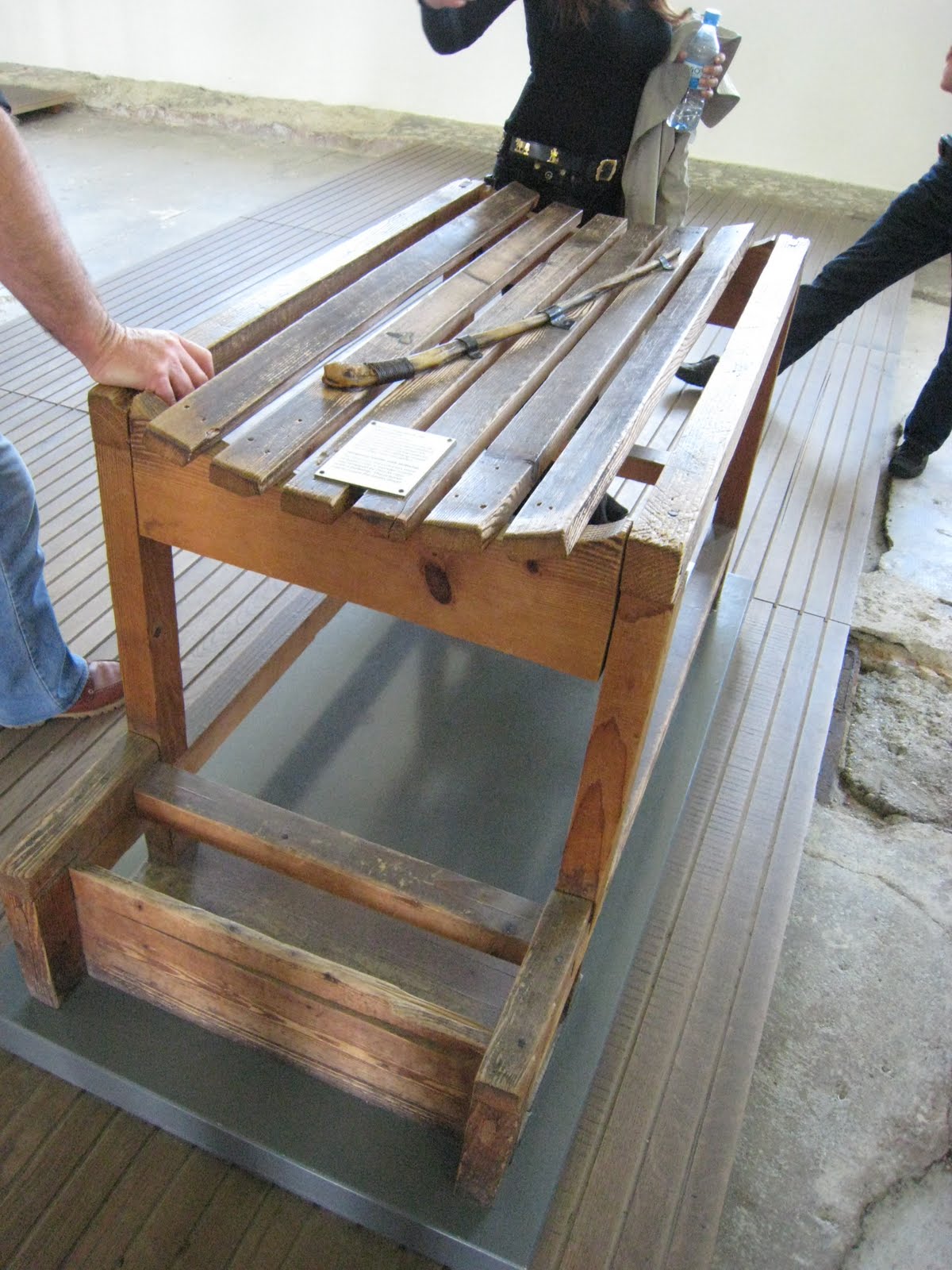
The Beating Block in the Punishment Room is a replica.

Usually the prisoners laid on a wooden table and were being beaten on the back with a rod 25 times. The prisoner had to count each hit in German (which meant if they lost count or couldn't count in German, they'd just keep getting beaten). Eventually one bright Nazi figured out a prisoner could get hit by two people, and each double-hit counted as "one".

Pole Hanging

They hung prisoners from a tree, pole, or cross (for Catholic priests). This activity originally was performed outside. With their arms behind them, but raised over their heads, the prisoners were beaten. Eventually their arms popped out of their sockets. Fellow prisoners would cut them loose and put their arms back in the sockets.
Psychologically, the prisoners were scared they'd be hurt too badly to work and get sent away for a "special treatment" (in the castle where lethal injections were administered).
Later Pole Hanging was done inside the building. Prisoners were hung from their wrists and tied to poles. The windows were left open so people outside could be tortured by the screams.

Standing Cell
A two and a half foot square cell forced people to stand in the dark for days. Once a day, they were fed bread and water.

The guy who tried to kill Hitler got a suite in the building because Hitler didn't want anyone to know about him. The would-be assassin was a Black Forest kuku clock maker. Clocks are a lot like bombs. He knew Hitler spoke the same propaganda speech in the same building at the same time once a year. He planted the bomb the day before Hitler arrived and took off for another country.
Because of bad weather, Hitler was forced to leave a little early and go by train, rather than plane. 10 minutes after he left, the bomb went off (as planned), killing 8 people but not Hitler. The assassin didn't know that, and kept checking newspapers, looking for headlines blaring Hitler was killed.
People thought he was crazy when he boasted he'd killed Hitler. Even after learning Hitler was still alive, to prove he wasn't nuts, he drew plans for the bomb. People finally believed he wasn't raving and shipped him back to Germany.
Hitler was totally embarrassed that a stupid clock-maker nearly did him in, so he hid him in the suite in the Bunker. 3 weeks before Dachau was freed, he was executed.

Prisoners leased or sold as workers for other countries or companies were returned and they wanted their money back because the prisoners were so broken and sick they couldn’t work. (Prisoners were told they’d be freed if they worked hard enough, and were still too weak.)
Ravensbrook was a women's camp. Women were told they could "work" for their freedom by prostituting themselves. Men sometimes earned money by working for the Nazis and could buy a prostitute for 2 cents. The "working women" never left the camp and died there.

The area between Maintenance Building and the Barracks was the square where prisoners gathered for roll call. They stood there for hours in extremely hot and cold temperatures as another form of torture. People died standing in roll call.

All German schoolchildren are required to go to a concentration camp.

We were given 20 minutes to walk around.
Mom and I tried to get into the documentation area, to see if we could find record of those in our family who didn’t survive WWII, but no one answered the bell. We‘ll email later and ask if they have any records from Mom's Great Grandpa's family. Mom doesn't have the first names of those who stayed in Germany, but maybe there's a letter or picture with the name of someone who immigrated to America.
The sun was out and it was warm today. Ate sitting outside the gift shop and on the bus. Chatted with the gals from TN. Our guide got sucked into the conversation. She said sauerkraut helps you lose weight. Cabbage in soup does the same. Speeds up your metabolism. She's still gained 10 lbs here from eating bread and cheese. In August she'll get a work visa so she can get a real job, and stop being a tour guide. She wants to manage PR for Expedia – global company, so she'll get to travel all over Europe – for pay.
While waiting for the train, gave her my card and we chatted. Colette thinks I'd make a great commercial actress. We'll see if anything happens.
Once we got off the train, Mom and I chatted with the TN ladies, who were heading to Oberammergau to see the Passion Play. We gave them tips. One gal's church has put on the same Passion Play, several times, in English – including the live animals. They even have the camels!

Mom and I found Matt and Dad by the statue. They'd eaten, but we were starving. I thought Matt said he got his turkey wrap near the hotel. "Near" wasn't very descriptive.
We got on the subway, and popped out on the big empty lot where Oktoberfest is held. HOT. Sunny. Awful. If I'd known about walking in the sun for so long, I'd never have agreed. Then up an hill and across a few blocks (in the sun).
We were the only ones in the restaurant. Mom and I both had the chicken wrap, which was good. The server was impressed with my German. I didn't use many phrases and sentences, but used them well. Ate both halves of my wrap – twice the protein I usually eat, plus most of Mom's "wrap" tortilla, plus a few bites of Matt and Mom's ice cream. I wasn’t full, but finally stopped feeling hungry.
I gave our server a piece of candy, which he took for his daughter. I asked how old she was, in German "How many" then accidentally switched to French when I said "years". Turns out the guy's French. So I flipped into French as we departed. Asked Matt the words for week and year in German as we walked in the cooler afternoon weather back to our hotel.

OKTOBERFEST FIELD - Took a few pictures of Matt acting goofy (his request).

ST. PAUL'S – Great views as we walked to our hotel.


Matt snagged the PC so I changed into shorts and stretched. When Matt returned I worked on finishing yesterday's Diary while he read.
He took a break to snag a beer from the hotel, panting. "Ok. I have a new rule. I can drink all the beers I want as long as I run up and down 8 flights of stairs to get them." He buys the beers from the hotel. Cooled in a cooler, you're supposed to write down your room number and what you snagged, then at the end of your stay, you get billed for them (if you're honest). Germans are more trusting than Americans.
Mom came over and we talked about what to do tomorrow and Sunday. Mom and Matt wanted to call Peter and Marlies, so Matt figured out how to dial their number from my phone.
Peter tried to wheedle us back to their place. Nico is out of the hospital and doing better. They figured out what time we were planning to arrive at the Dresden hotel.
Matt fortunately fell asleep while I was typing on Diary, but not for long. He finally kicked me off the computer around 12:30, just as I got to where I could go back and sort yesterday's photos.
Matt said, "If this is the biggest problem we have as a couple, I can live with that." I agreed.

Tuesday, July 13, 2010

GERMANY TRIP BLOG - DAY 12 – 6-3-10 - MUNICH – Residenz Treasury & Museum – Hofbrauhaus – Churches: Damenstift – St. Michael’s – Frauen – St Peter’s

We took the underground to The Residenz. Just before it, we saw….

THEATRE CHURCH – An immense gold colored building. To the left of it was the….

NATIONAL THEATRE – Immense light gray building with two triangles on top. The top-most one was golden, with statues inside. The other was of the same stone color as the theatre, also with statues. I suspect they were to imitate the Parthenon. In front of it there's an amazing, huge statue of….

MAX-JOSEPH – Maximilian I – Bavaria's first king.
In 1806, Napoleon let him be king if Max's daughter married Napoleon's stepson (making his son royalty). Max emancipated Jews and Protestants.
Munich became the capital of Bavaria when Max's son (Ludwig I) ruled. When Ludwig I got married, his wedding festival became an annual event, now called Oktoberfest.

MUNICH RESIDENZ
From the 1300's, it was a political and cultural center for dukes, then starting from 1623 the electors, and finally (1806-1918) Bavarian kings, mostly made up of the Wittelshach family (King Ludwig's line). The various rulers added on to, decorated and furnished the palace as they pleased.
The palace was mostly rebuilt after WWII destroyed parts of it. Part of the front (covered with a huge tarp with the picture of what it's supposed to look like) was modeled after Medici's Pitti Palace in Florence.
There was something made of brass outside – shiny from where people obviously touched it for good luck.
We walked through doors into an immense entry that went into a garden area with statues, and from then into the entry hall of the palace, where we saw a model of the outside of the palace. The first floor has 93 rooms, and the top floor about 120. Many were lavishly decorated with fancy furniture or items.
We checked our coats and decided to go through the Residenz Treasury first.

RESIDENZ TREASURY
Founded in1565, there are 1250 items, not all of which were talked about on the audio guide. If listened to from start to finish, the audio guide would have taken us 5 hours. We selected numbers for what we wanted to learn about. Most objects, I just photographed. Mom and I tried to take pictures of different things.


ST. GEORGE SLAYS THE DRAGON – 1556 –
One of the two main items. This is about a foot long, covered with jewels. A rope across the front made me wonder if I should walk through the open ends – it didn't completely block the way, and I didn't want to set off alarms, so took pictures from behind. A while later, Matt told me he read in Rick Steves that it was fine to get up close, so I went back and took photos of the exquisite detailed work.

HUGE JEWELED NECKLACE – 1565

Emeralds are fake. Real ones auctioned off for money.


ALTER BOX – 1573
Inside middle, the back was facing out on the other side. The original, super fancy inside was lost or destroyed, so they flipped the back around.

IVORY CHRIST ON CROSS – Matt pointed out how the nails force the flesh to sag and hang around them.

TINY CERAMIC FIGURES (1600's) IN FANCY GRAY STEEL ENCLOSURE (1700's)

HUGE BOX WITH PICTURES ETCHED ON CRYSTAL – carved scenes from the Old Testament

HUGE CRYSTAL BROACH - 1604
Made for a woman. There's a painting of a woman with it sewn on her sleeve. Military themed. Has a knight's uniform in the middle of it.

2 IVORY GLOBES – 1570 – One of the constellations, one of the world.

SMALL ST. GEORGE & DRAGON – 1570 – ceramic

COLLECTION OF WATCHES – 1600'S
Most of them look more like a compass (with a lid) and were primarily for decoration, rather than function.
Pocket watch with 4 small circular faces in it.
Ring watch – 1585
Watch pen – includes calendar and multiplication tables

TURK WITH CLEAR BLUE HEAD – 1520 – Bust of a female with a light blue sapphire head.

PARROT HANGS BELOW TINY SCENE – Parrot added later. Circle with tiny scene above it was created in the 1500's.


BOX TRAVEL SET – 1810
Made for Napoleon's second wife as a wedding gift. Includes dental tools, sewing kit, dinner service for 2, writing utensils, seals, opera glasses, a ruler, a drill…….

CROWNS – 1800's
Never worn by Bavaria. Made by the same shop in Paris that made Napoleon's crowns. Bavaria joined the anti-French alliance, and the crowns were now "too French" to be used.

Didn't quite finish looking at everything. I was hauled out of the last two rooms quickly because everyone else was waiting for me. I tend to get really focused when bedazzled like this. (Great for performing, not always so good for “real life”.)
We took a break and then got our bags back so I could eat and drink before we continued. Stuffed a bunch of dried fruit in my mouth, drank water, and called it good. Good thing I ate, because we spent the next three hours in the "museum" which was actually the rest of the palace.

I mostly ignored the audio guide and focused on taking pictures of the opulent rooms.


RESIDENTIAL MUSEUM


SHELL GROTTO – Ground Floor, Room 6 – Original 1550 – Rebuilt after WWII.
Didn't know I could take pictures. DAMN IT. Red wine used to spurt from the mermaid's breasts and drip from Medusa's head. Decorated with Bavarian shells. After it was bombed, the Bavarians from small towns collected and donated shells for the reconstruction (Nazi photos showed what it looked like).


ANTIQUARIUM – Ground Floor, Room 7
Real Greek and Roman statues mixed with replicas. 1/3 of the statues in the room are real. Most are fakes created by Romans during the Renaissance to sell to wealthy European families.
I think I found one of the real statues. Can see where it was colored, and didn't have any red (fake purple marble) on it. Plus many of the tassels on the shawl were broken off. I pointed it out to Mom.
1550's paintings of small surrounding villages on ceiling are the originals (survived bombs). 120 Bavarian villages.

GALLERY OF THE WITTELSBACH FAMILY – Ground Floor, Room 4 – 1740's
All official guests had to pass through to meet the Duke. Family tree in the center.
Basically a scrapbook that takes up a room. Ceilings are white – bombs destroyed paintings on them.
The portraits are originals (quickly cut out of their frames before the bombs hit)

NEMPHENBURG PORCELAIN – Ground Floor, Room 5 (at end of family gallery) – 1700's
Whittelsbach's had their own Nemphenburg porcelain made for the palace (something only the richest and most powerful could do)

RED ROOM – Second Floor, Room 62
Coral red – the most royal color in Germany. Contains miniature copies of famous paintings, done with a single brush hair.

PRECIOUS ROOMS – Upper Floor, Rooms 55-62
Long string of rooms just for show.

BEDROOM – Upper Floor, Room 60
The Duke publically went to bed and got up, (first and last audience of the day held here, like Louis XIV did).

CHAPEL – Upper Floor, Room 89
Site of Mad King Ludwig II's funeral.

RELIQUARY – Upper Floor, Room 95
Skulls of John the Baptist & his mother Elizabeth on jeweled pillows.

PRIVATE CHAPEL OF MAXIMILIAN I – Upper Floor, Room 98
Miniature pipe organ from 1600 still works. Stucco marble – stucco applied and polished. Was cheaper than the real thing.
Post-Renaissance perspective tricks on walls.
Case on right as you enter supposedly contains 3 babies form Herod's slaughter after Jesus birth in Bethlehem.


ORNATE CHAPEL


HOFBRAUHAUS
We had lunch at the nearby Hofbrauhaus restaurant. Hofbauhaus is one of the six major Munich breweries. There's a room where regular customers have their personal steins locked up. Some are centuries old, and people were stealing them (thus the lock and key system). Huge rack on the wall and the mugs are mostly surrounded by a band of steal, plus there's a little door in front, each with an individual lock. A few guys run the room and clean the steins after they are used. There's a bouncer at the door who nabs 20-50 people a day trying to steal beer mugs (the thieves are mostly Italians).
(When we first arrived in Munich I thought everyone was talking about going to the "opera house". Yesterday, Matt told me there wasn't an opera house here, and thought it was hilarious when he realized my misunderstanding. It’s an easy mistake to make!)
Crowded! Very loud – plus a polka band that played every 15-30 minutes. They serve huge steins of beer, and Matt said the serving women can carry 6 in each hand. Dad wanted me to take pictures of them, and then took a few of Matt and I.
Mom ordered choc. mousse. Still hungry after lunch, even after eating some dried fruit from my pack and some of Mom's choc. mousse. Matt promised me a French pastry, but we never got to it.

Dad's ankle was really sore (a condition he's had for decades – particularly when hunting), so he wanted to go back to the hotel. Matt gave him a lesson on the subways, which was followed by additional mini-lessons and clarification from Mom and Matt.
Matt told him several times he'd pay the extra 5 Euros to put Dad in a taxi, but Dad really wanted to do the subway himself. Bought his own ticket and everything. Mom said he'd surface eventually. (He only got confused twice on the way back – not bad!)
Mom, Matt, and I wanted to see 4 fancy churches Matt knew about from the Rick Steves book. Matt's an excellent tour guide, and patiently waited while we clickety-clicked away with our cameras.

MUNICH #1 – SHIRT RAINBOW - Matt pointed out an "S" shaped curve of shirts in a shop. Each a slightly different color, to form a rainbow. Must have been 20 of them.


DAMENSTIFTSKIRCHE – Woman learning? Church
Aside from looking amazing inside, contained life-sized statues that are painted from The Last Supper scene. There's a gate between the entryway and the main part of the church. We didn't go past it, and just took pictures as best we could from were we were.
Later, asked Marlies what Damenstift translates into. She said it’s a school for older women. They are kept apart, so it’s sort of like a nunnery, but different.

MUNICH #2 – TALL COLUMN FOUNTAIN -
Walking to and from the church, we passed by a fountain that spilled over unevenly. Tall pillar with 3-D carving all around it. The top was a bowl, but the water spilled out unevenly, as if there was a ball rolling around inside it.


ST. MICHAELSKIRCH - ST. MICHAEL'S CHURCH – late 1500's
Destroyed in WWII. I took photos of the photos of the destroyed church, as well as loads of photos inside it.
Front façade - shows St. Michael fighting Protestant demon
Has a crypt of 40 Whittelsbachs (including King Ludwig II) but we didn't see the crypt.

MUNICH #3 - MUSHROOM FOUNTAIN – Large alcove made out of small cement blocks, with a pool that had big mushroom water fountains.

FRAUENKIRCHE – METROPOLITAN CHURCH OF OUR LADY – late 1400's – dome late 1800's
Bombed in WWII – only the 2 tall towers survived. Pretty much demolished, but they decided to rebuild it. Amazing things used to be hanging on the columns. Black, big, ornate tomb in the back is for Ludwig IV, who died in 1347. His grave used to be in front of the alter.
Used to be as fancy as the others, but they rebuilt columns comprising of the body by the pews so they are plain. Someone repainted the ceiling using Nazi photos taken before the war.
There were a gob of alcoves on the sides. Not sure what was old and what wasn't. I took pictures of some stuff I guessed was old, or that looked cool. Mom took a lot more photos than I did. People were praying, in the front pew. Some people just took pictures, completely ignoring the people praying in the pews.
There was a man in the front pew who was really praying hard. I refused to walk in front of him, just to get better pictures. People first. I hope things turned out ok for him. He was deeply troubled.

MUNICH #4 – MAN ON BEAM –
Larger than life-sized man standing on a steel beam coming out of a shop.

Because it wasn’t pouring, or even raining, we decided to once again go see….

MARY'S PLACE
Took better pictures of the statue of Mary and the 4 smaller statues beneath it.
NEW TOWN HALL GLOCKENSPIEL – Got better video of the knight falling back during the joust and dancers. Much clearer without the rain.


ST. PETERS – original – 1158, rebuilt after bombed in WWII
Built, added to, and revised since before 1200, it was then completely destroyed by bombs in WWII. It's been reconstructed, though the naves are in a different order. The frescoes were repainted.
THE ALTAR
Wooden pillars on hight pediment of marble – 1730-1734.
St. Peter on his throne – 1493-95
4 statues of people around St. Peter – 1732-33
Tabernacle below Peter created by 2 artists between 1749-86.
2 angels on either side – 1804.

CEILING – Peter crucified upside down

PILLAR STATUES
ANDREW – 1710
To the left of the altar is a statue of Andrew, with one hand on a large wooden X and the other holding a book.

PAUL – 1710
To the right of the altar

REST OF THE APOSTLES – 1753-55
One on each pillar, because they are "the pillars of the church"

MARY - 1710

CHRIST – 1710


PULPIT – 1753-55 – Wrapped around a pillar on the right and sticking out over the pews.

GOTHIC CHAPEL ALTER (located front-left) – survived the bombing, by being buried in sand bags.

CORPUS CHRISTY ALTAR – 1757-58
Behind marble railing is a small altar with a huge gold something in the middle. Behind that there’s a large painting of the last supper (1644) in a frame that has 2 pillars on each side. The top of the frame goes up for a while, with golden angels on it. Above the frame is a fresco painted on the ceiling.

TOMB OF MUNDITIA (2nd chapel on left side after you enter the building)
Martyr from 200's. Roman casket with red lettering. Given to Munich by Rome.

GRAY IRON FENCES – made by local railroad blacksmiths after WWII

ORGAN – 2003 – reconstructed from one made in the 1700's.


Walking back to our hotel, the streets and subway were remarkably empty. We figured it had to be some sort of holiday, because the restaurant we ate at last night is closed tonight, as are most restaurants and a lot of the shops. When we got to the front desk, we asked and learned it's a Catholic and Batavian holiday. (Learned later from Marlies the people usually parade through the city, stopping at flowered spots to pray before continuing. The parade in Zeeben passes right in front of her daughter Nani's house, so she can't drive out. Pisses her off. This year, due to rain, the processions were inside the church.) There are finally more than a handful of people in the hotel.
We ate the food we already had.
I started sorting photos from June 1, hoping to finish before Mom was ready for me, but it was only about 10 minutes later when she came up.
She brought her old Mac. So old, it has real problems copying files form outside devices (like her camera), because another program keeps interrupting the file moving after 30 seconds or so. If she saves them directly to her desktop, then the files are scattered all over the place – on the desktop. Takes her a long time to download her photos this trip.
We tried various things, but I have too many images. Some were transferred, but it was too hard to figure out which ones, so I gave up after 20 minutes.
Matt's new laptop will probably keep working just fine, but I've worked too long with computers and won't feel secure without a backup. I should have listened to Matt and brought my Wolverine external hard drive. I didn't realize how much space I'd need.


ST. PAUL'S
While deleting bad or extra photos from my memory chip, Matt had the window open and saw that, outside our hotel room window, St. Paul's was lit up really pretty. He got my folks. I took a few photos.
I finished deleting bad and extra photos taken today form my memory chip, then downloaded them while I finished getting ready for bed.
Finally sorted the rest of my June 1 photos. For a while, I wrote today's Diary, while also sorting today's photos. Doing it all chronologically, but Matt was getting snippy and wanted me to turn off the light. I quickly outlined the rest of today's events.
It was around 11:30. Read for nearly 2 hours. Just not sleepy. But typing makes noise, which makes it harder for Matt to sleep, so I'll just hope tomorrow I'll have enough time to catch up.